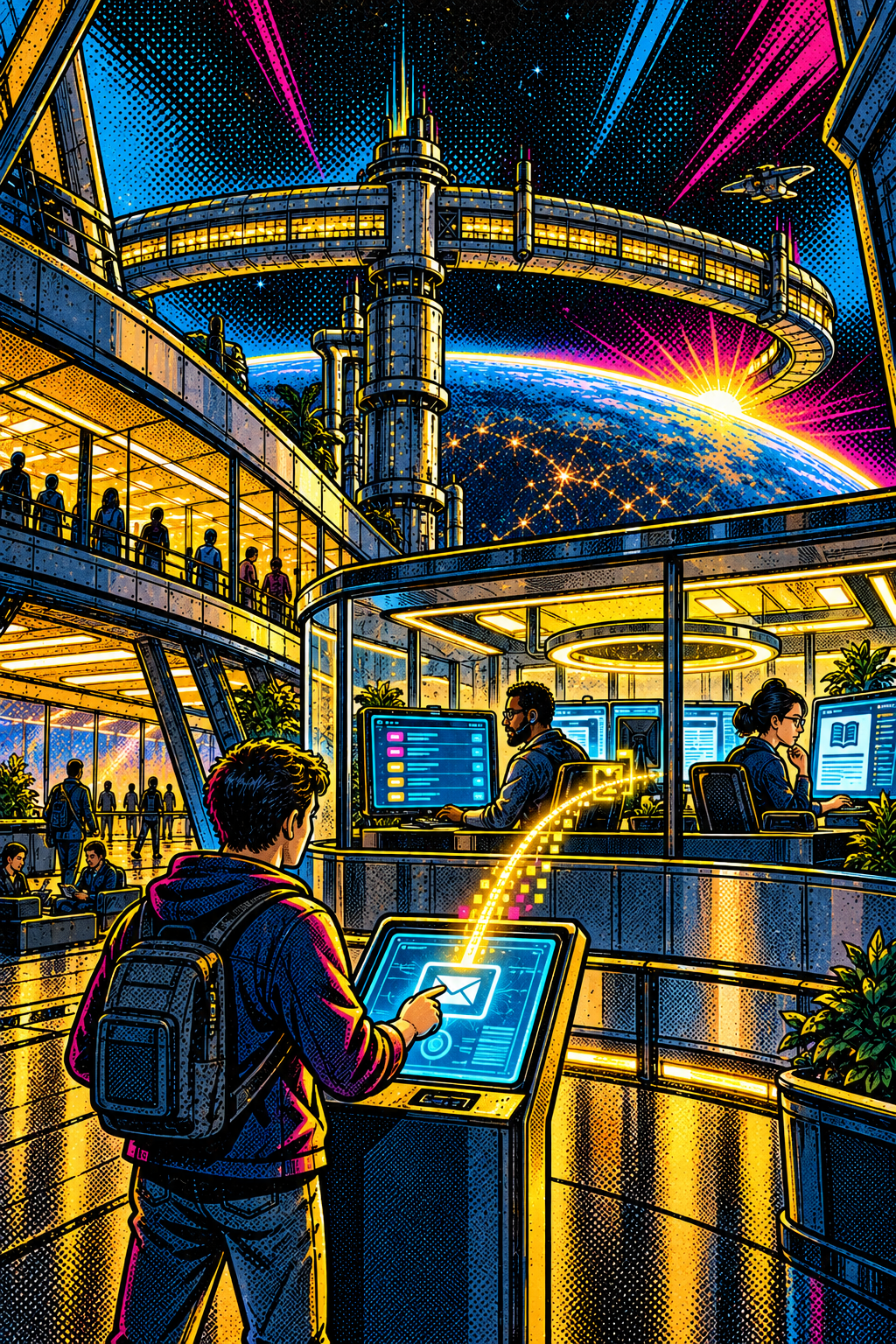
A working desk inside the Watchtower.
The station is more than a backdrop for a future bot. People can bring requests into GLPI, the IT Service Desk can pick them up, and technicians can answer in a separate working view. The desk was built and exercised before Rover joined the story.
The handoff is real
Clark’s synthetic request moved through submission, assignment, public follow-up, solution, acceptance, and closure. Later training tickets 4–9 were assigned to IT Service Desk; Ted’s public triage, refusal, and approval-request responses were saved and read back. Those are human-operated lab workflows—not AI-run support or six completed scenario outcomes.
Identity meets permission
Active Directory supplies the workforce identities and group membership. GLPI applies its own Self-Service and Technician profiles. Barbara and Ted have the technician role; the remaining human accounts have Self-Service access. Five workforce articles and four technician references were imported with separate audiences. A reported browser check denied a Self-Service attempt to open ticket 9, while model-level article checks showed technician references hidden from Clark.
A desk that can recover
HTTPS, service restart, and an isolated GLPI backup-and-restore check have separate receipts. A controlled WS03 connectivity fault was observed and reversed, with its evidence added privately to ticket 6. That check did not close the ticket or claim a requester-approved resolution.
A multi-ticket, staffed, role-bounded help-desk lab is operating. Full six-scenario handling, every role combination, and whole-host disaster recovery remain distinct checks—not prerequisites for acknowledging the working desk.
Illustrated fictional setting; engineering notes describe synthetic lab work, not customer incidents. Original artwork; no DC affiliation or endorsement.